01
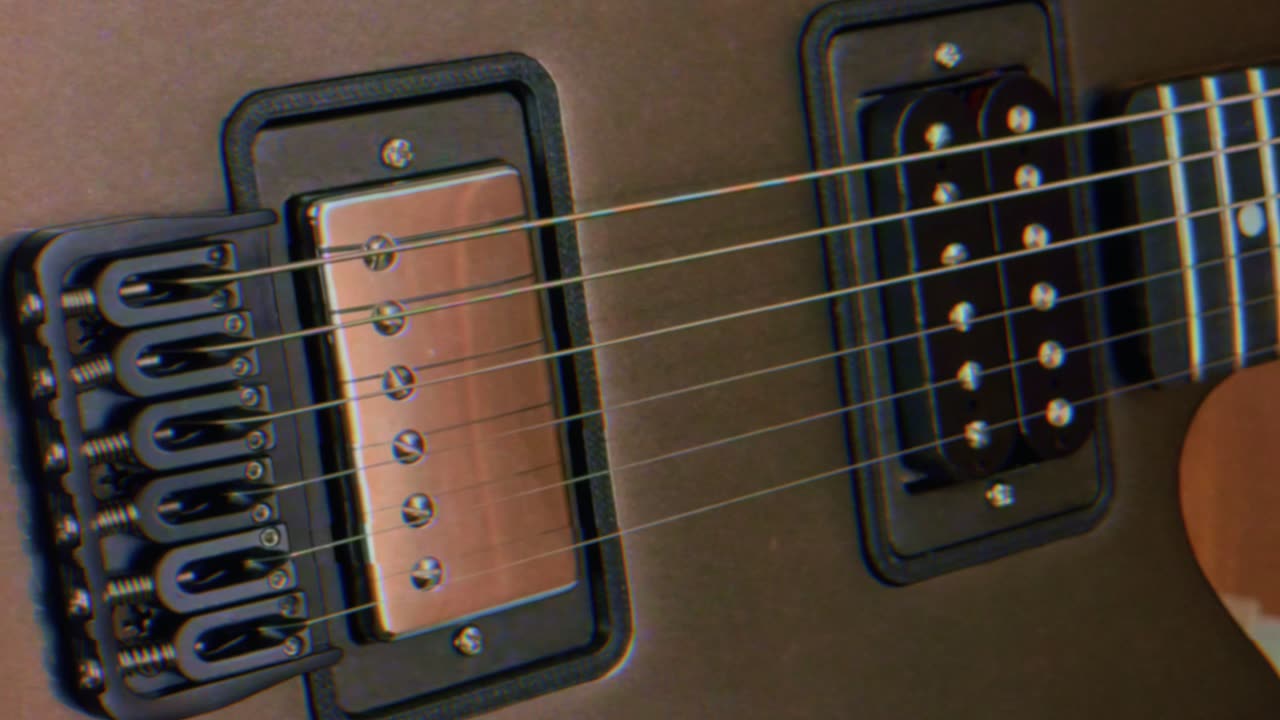
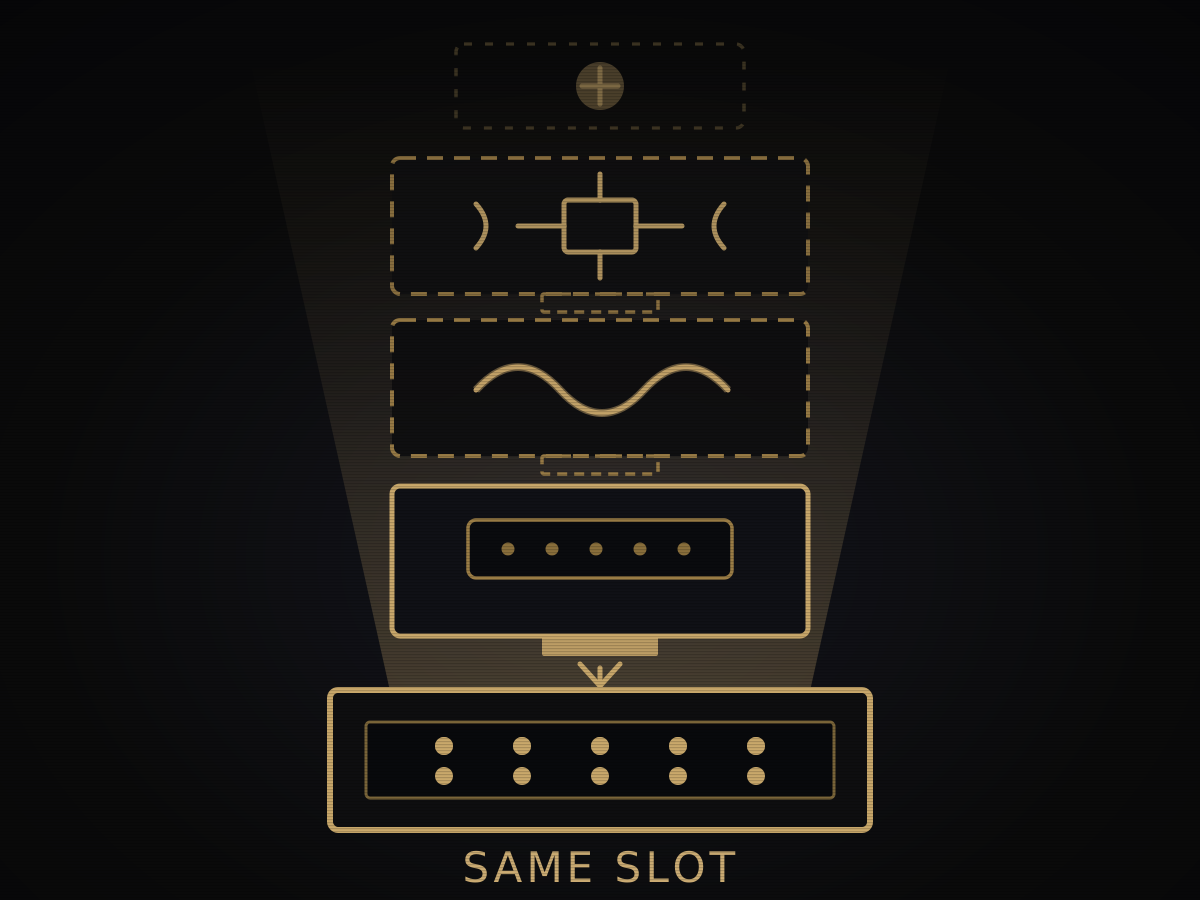
Most of an electric guitar's sound comes from the pickup. On this one the pickups sit in two slots — neck and bridge — and lift out by hand. Humbucker, single coil, P90, active: a library of sounds at the tip of your fingers.
PRJCT-01 Filum. The Cartridge System.
A 79-second walkthrough, recorded direct from the guitar. Headphones recommended.
Sound on · 79 seconds · recorded directStraight from the guitar — no amp, no microphone. One of the cartridges in this video is an empty shell with an off-the-shelf pickup clamped in — an empty shell takes whichever pickup you like, active or passive; the guitar powers active pickups itself.
The guitar in the video above is a finished prototype — built, playing, and in pre-production validation, though some details may still change. The cartridges marked prototype further down this page are a different thing: those have no date.

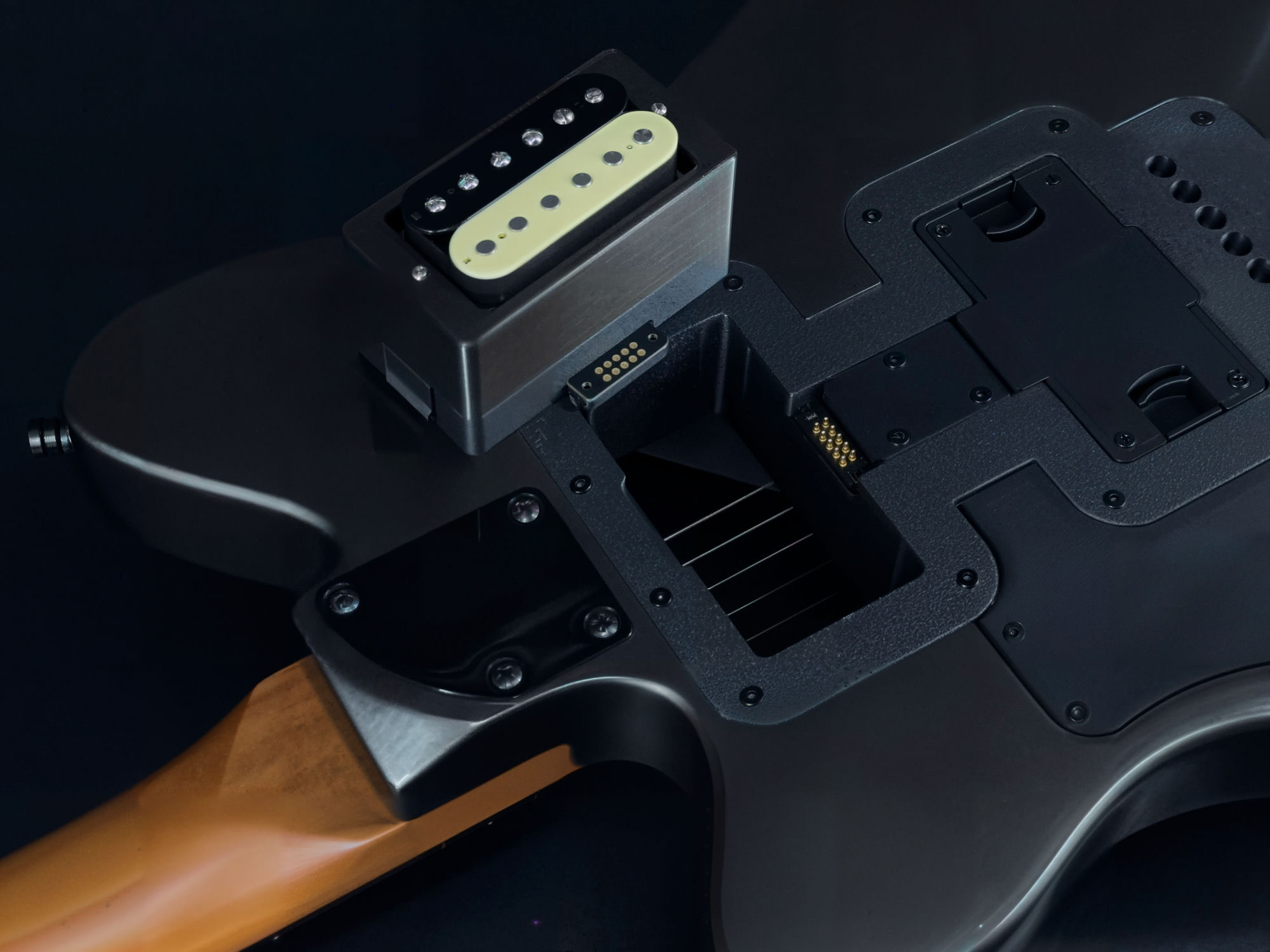
Filum's answer is blunt: put the whole pickup into a cartridge. The old way meant strings off, covers off, a hot iron, four wires out and four wires in — then restring, retune, and set the pickup height again, hoping the phase came out right. Hours of work, and for most players a trip to a tech.
Here you lift one cartridge out and drop the next one in. No tools, and the pickup height rides with the cartridge, so it arrives where it was. Two slots, neck and bridge. We call it the Cartridge System.

The print lines on the shells above have not been retouched out.
Sound on · 2 min 10 sec · recorded directSame phrase, same rig, same camera position — only the cartridge changes — and you hear each one in the neck and bridge positions. The sections were recorded separately, not in one take.
Empty cartridges come in every size. That Lollar in your drawer, the PAF you've had for ten years — the leads drop into WAGO lever terminals: lift, insert, close. Five minutes, no iron, and solder pads are there too if you'd rather.
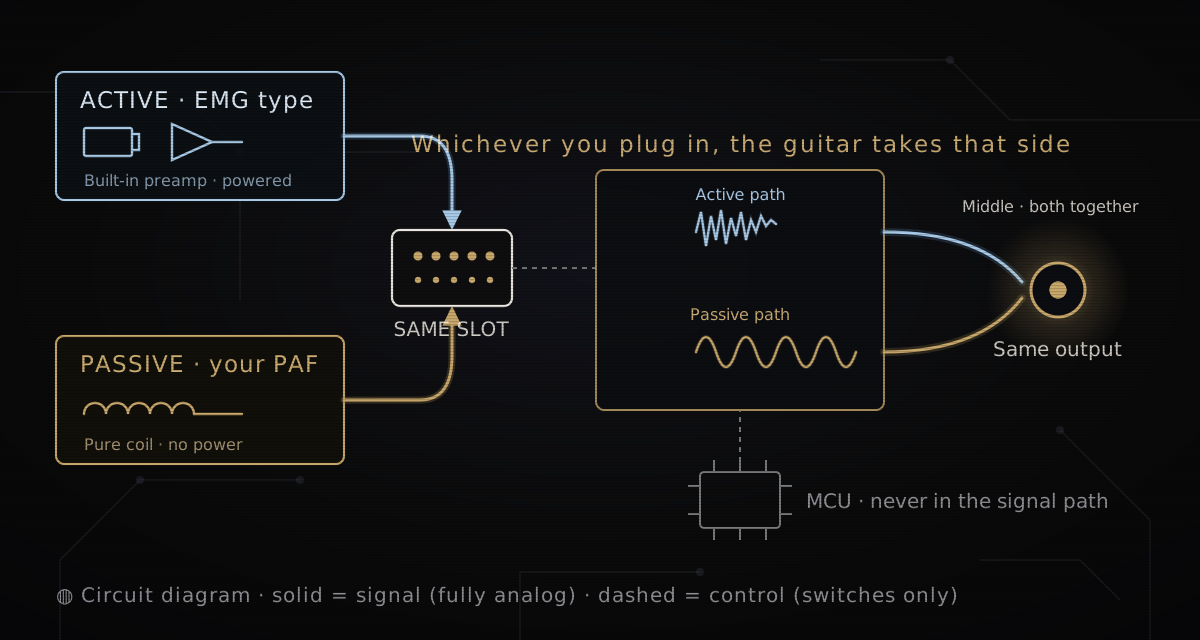
Active pickups work the same way: the terminal block carries power from the guitar's own 9V, so there's no separate battery box to find room for. Sizes are humbucker, single coil, and full-size P90 soapbar — an actual soapbar, not a P90 squeezed into a humbucker cover. Nine out of ten pickups on the market drop straight in, though we haven't put every pickup ever made into one. (Solderless wiring is for pickup cartridges; the DSP and Sustainer cartridges are built differently.)
P90 is in the first batch too — a full-size soapbar, not a P90 squeezed into a humbucker cover.
The shells are ASA, printed in small batches for this run. Matte black, and never gloss.
← Swipe for more
Tap a card for the full picture ⤢



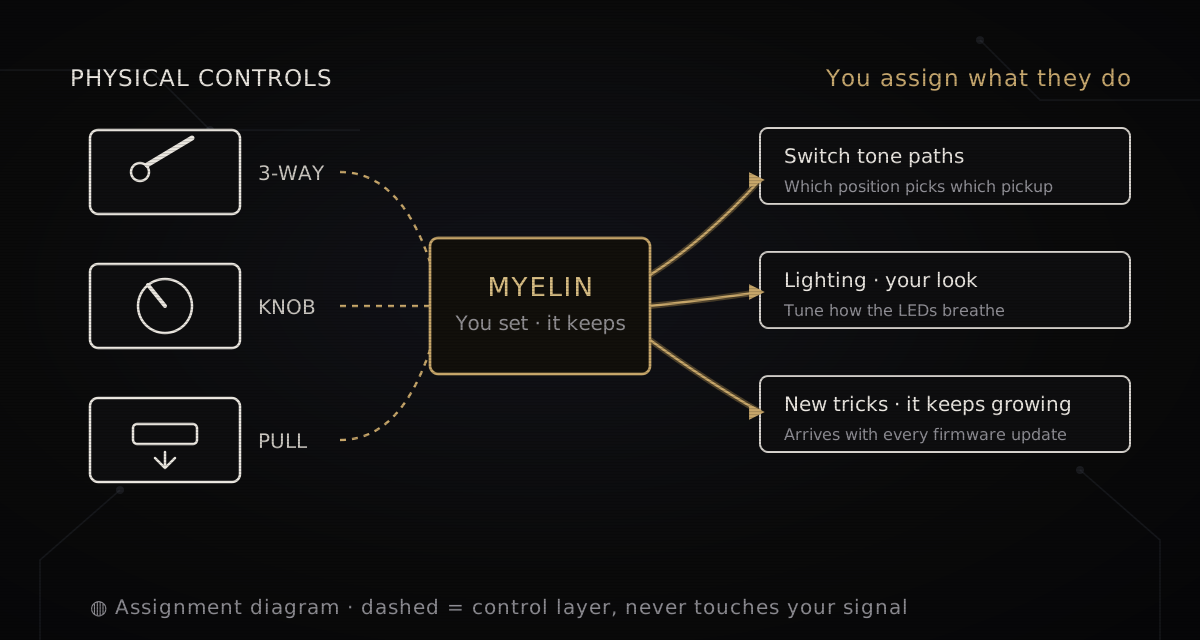
Myelin is the guitar's own settings screen. What each control does, how the guitar is holding up — plug in over USB and all of it is editable in a browser tab, nothing to install. It handles settings, firmware and status, and it never touches your audio. Your settings live in the guitar itself, not in a cloud — no login, no subscription, and none of the guitar's functions depend on a service.

You don't need a guitar to try it — it runs fully simulated, and it makes no sound.
Myelin needs a desktop browser (Chrome or Edge). You don't need a guitar to try it — it runs fully simulated, and it makes no sound; the link goes to your inbox.
Tap any image to enlarge.
← Swipe for more
Tap a card for the full picture ⤢

← Swipe for more


More analog tones are being added, one at a time.
All three run today. All three use the same slot.
← Swipe for more
Tap a card to open ⤢
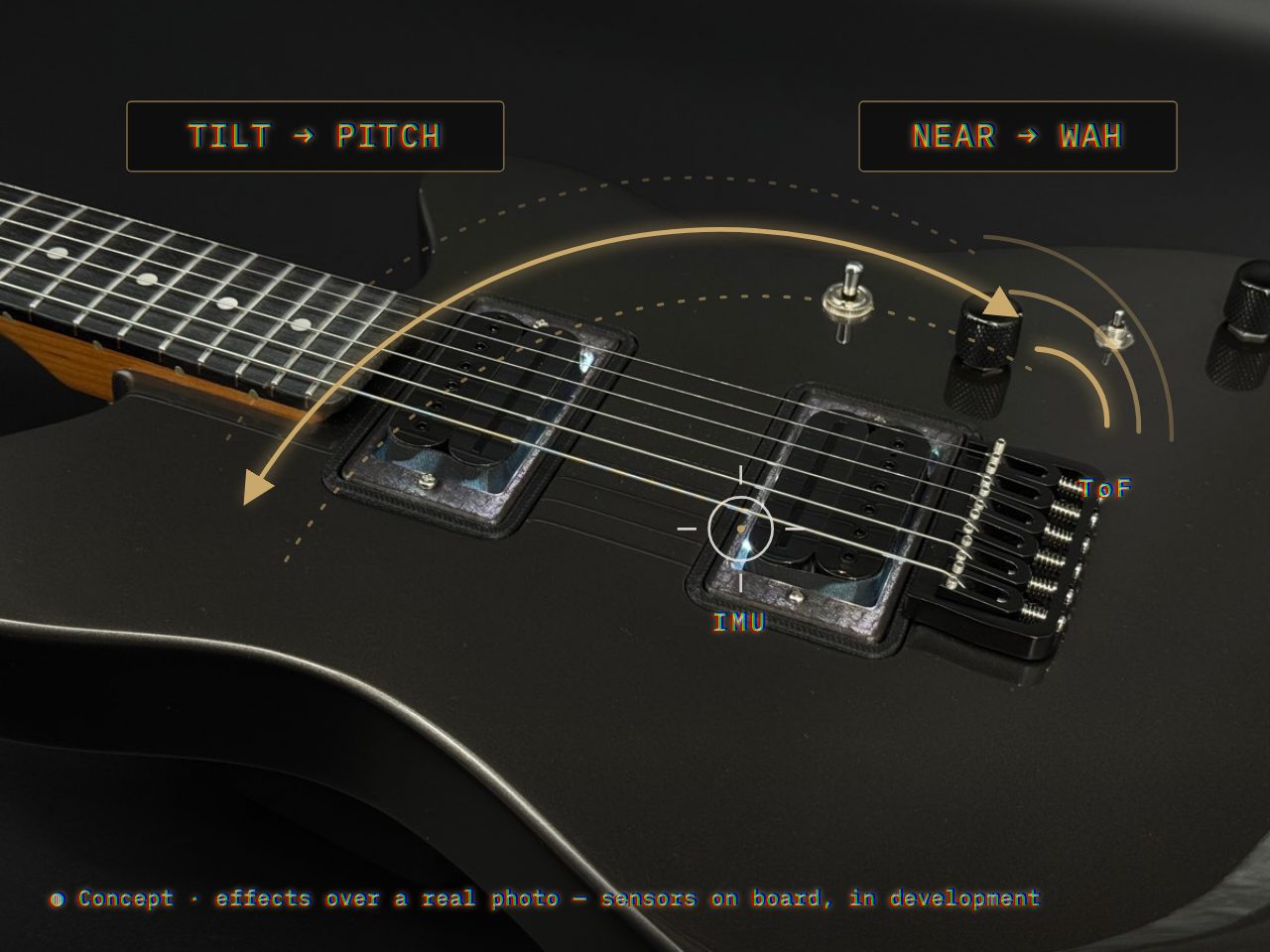
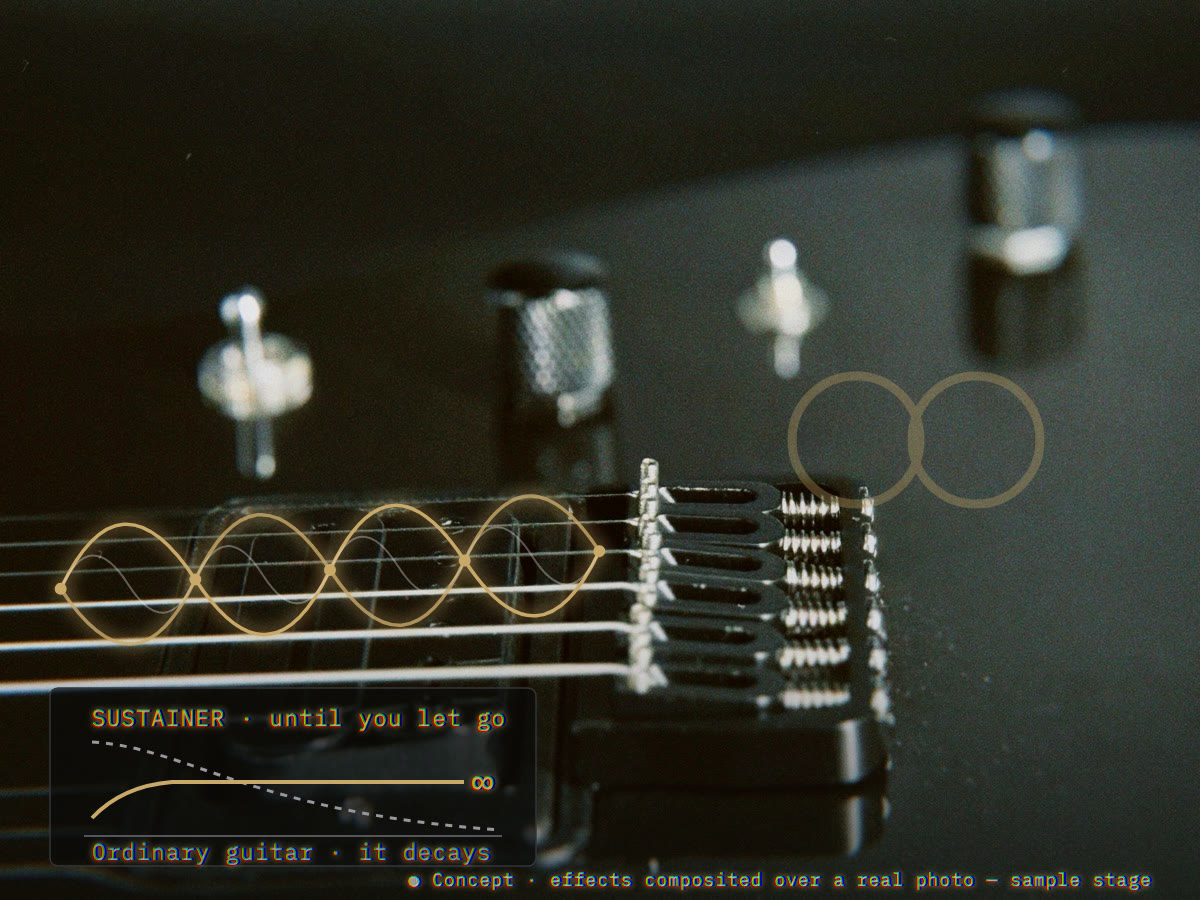

None of them is for sale, and we don't have a date for when they will be. What we can tell you is what's in your hands on day one: the slot, and the row of pickup cartridges above that already exist for it. Everything else that ever fits that slot arrives later, into a guitar you're already playing.

Is the instrument where your sound stops?
There is only one thing we set out to prove: that what you think can drive the sound directly.
PRJCT-01 is the name of the experiment. Filum is the first answer it has to show for itself.
We're starting in Taiwan — it's where we are and where the guitar was designed — and going outward from there. Shipping is planned for the second half of 2027. We'll publish the price when it's the real one.
When it ships, it ships as a complete, playable guitar — with cartridges in it. Not an empty one you then have to go and fill.
After you join: build progress, new cartridges, and the launch date all come to you first.
By submitting you agree that we may handle your email under our privacy policy. Ask us to delete it any time.
Want to check the details first? The full specifications and FAQ are below.
Or just write to us: hello@prjct-01.com.
| Body and neck | |
| Body | Alder, two-piece, center-joined; 45 mm thick |
| Neck | Roasted maple, quartersawn; C profile; satin finish |
| Scale length | 25.5" (648 mm) |
| Fingerboard | Black engineered wood; 12" (305 mm) radius; 22 frets |
| Frets | Stainless steel, medium jumbo (2.7 mm); crowned, ends rounded |
| Inlays | White pearl dots; luminescent side dots |
| Nut | Bone / synthetic bone, 42.8 mm (1.685") |
| Truss rod | Dual-action |
| Cartridge mount | PET-CF carbon-fiber composite; the base and the bridge base are formed as one piece. The cartridge itself carries no string tension. |
| Signal path | |
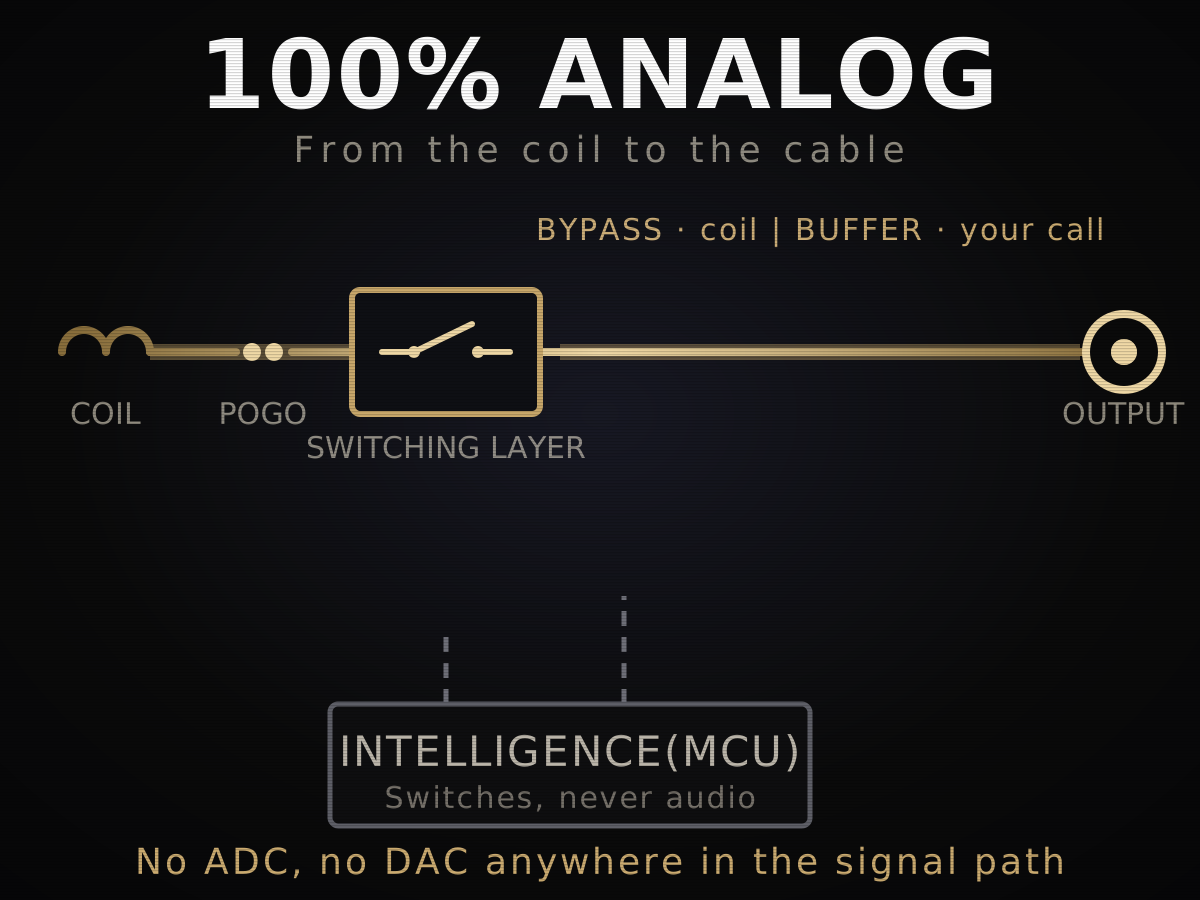
| Signal path | 100% analog on the passive path. No codec, no ADC, no DAC in the audio path — nothing on the board samples audio. |
| Buffer and boost | OPA196 buffer, 140 µA quiescent. A switch takes it out of the path completely; off means passive. Switchable boost, up to about +16 dB. |
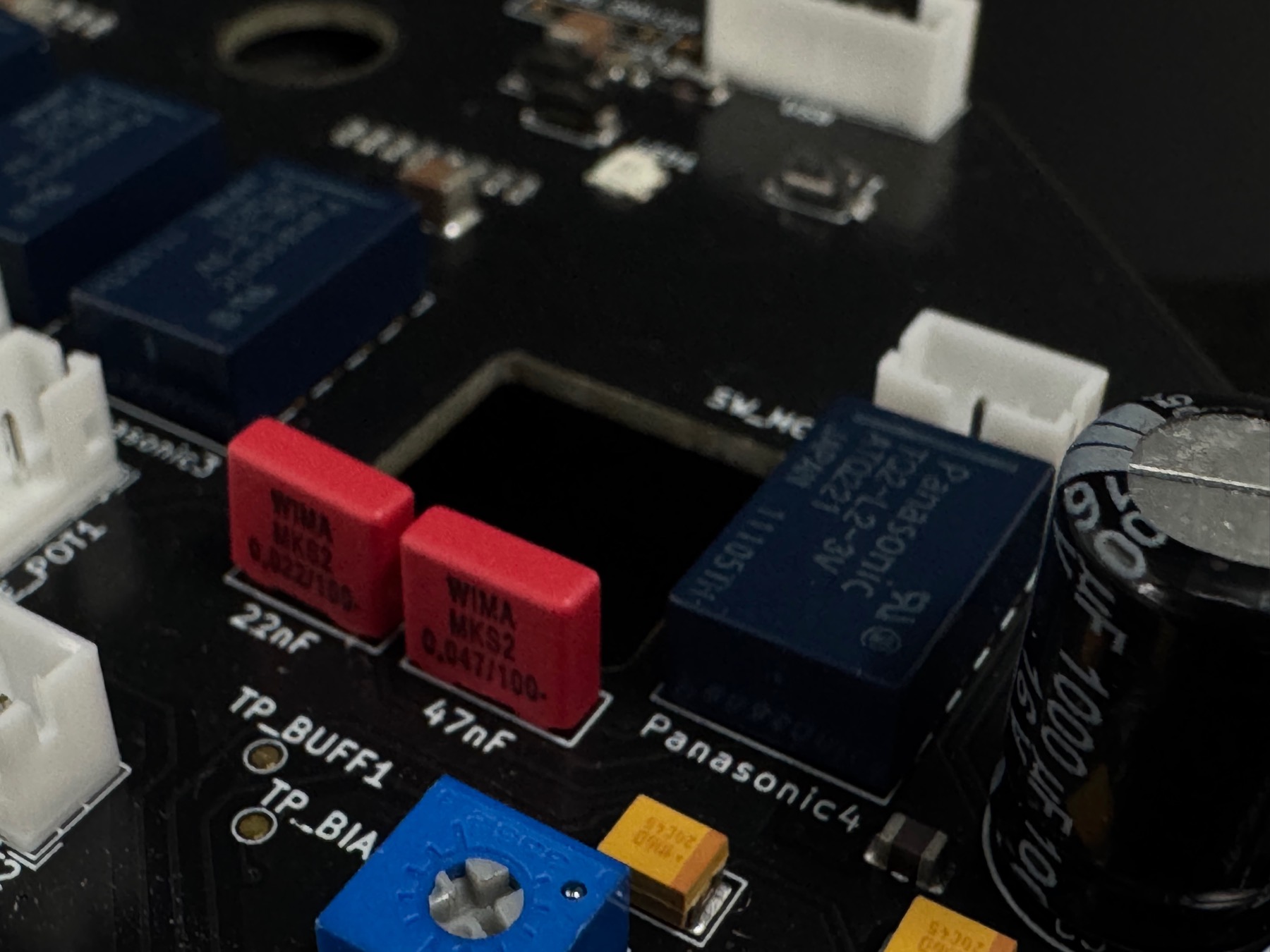
| Tone switching | Array of Panasonic audio-grade latching signal relays. Zero holding current once switched; the state survives with the power off. |
| Relay life | Panasonic TQ2 series. Rated mechanical life 108 operations — a hundred million (manufacturer datasheet) |
| Switching contacts | Gold-clad silver alloy; initial contact resistance ≤50 mΩ; minimum switching load 10 µA / 10 mV |
| Load matching | Set automatically when a cartridge goes in: 250 kΩ / 500 kΩ against a .022 µF / .047 µF cap — one pairing for single coils, the other for humbuckers. Two fixed pairings, not a continuously variable control. |
| Swap muting | The signal is muted around the swap. |
| Output | 1/4" (6.35 mm) mono jack |
| Physical controls | One 3-way pickup selector; two push-pull knobs (volume and tone — pull up to switch); one mini toggle (ON-OFF-ON). Assignable in Myelin Console. |
| System and software | |
| Control interface | Myelin Console. Runs in the browser, nothing to install. Desktop Chrome or Edge. |
| Stored settings | EEPROM in the guitar. |
| Firmware | Updated over USB from the browser (desktop Chrome or Edge). STM32 ROM bootloader built in for recovery. |
| Serviceability | Every control sits on a plug-in daughterboard; the only solder joint in the whole guitar is the output jack. The cartridge contact assembly is a wear part and is replaceable on its own. |
| Service life | One electrolytic capacitor is the only part in the circuit that ages on a calendar — conservatively about 15 years, replaceable at a normal service. Everything else has no wear-out mechanism and a design life over 20 years. Boards are conformal-coated before they ship. |
| Parts | Orderable from the site once shipping begins, and you fit them yourself — no soldering iron needed. Everything except the mainboard and the base, which go through service. Exact items and pricing are published once shipping starts. |
| Cartridge system | |
| Cartridge slots | 2 — neck and bridge. Hot-swappable. |
| Cartridge contacts | 10 × ENIG gold-plated pogo pins. The contacts are rated for 100,000 insertions. |
| Positioning tolerance | <0.1 mm. That figure describes how repeatably the mount seats a cartridge; pickup height is a separate matter, set inside the cartridge. |
| Pickup height | Set inside the cartridge, and travels with it |
| Cartridge recognition | The guitar knows which cartridge it is the moment it goes in. No chip, no NFC, nothing to pair. |
| Cartridge compatibility | Passive and active. Each lands on its own path, and the two can share a guitar. |
| Pickup wiring | WAGO solderless terminals, with solder pads as a backup. A PWR terminal is included — active pickups run on the guitar's own battery. |
| Blank shell sizes | Humbucker, single-coil, P90 (full-size soapbar). Every size is stocked, and the great majority of pickups on the market fit straight in. |
| Cartridge shell | ASA engineering plastic — weather- and impact-resistant. Printed in small batches for this run. |
| Power and protection | |
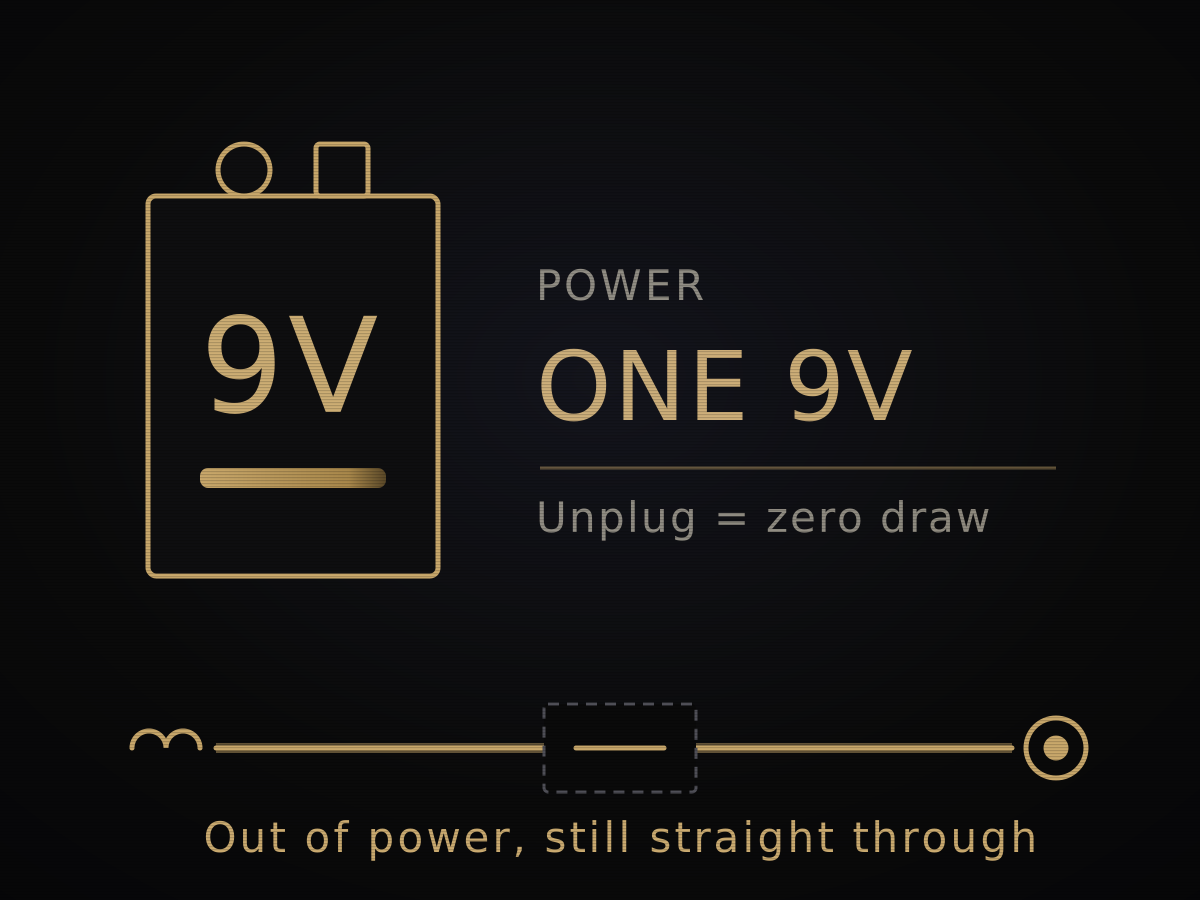
| Power | One 9 V battery, direct. No boost converter, deliberately — one less noise source. Works with 8.4 V rechargeable lithium (not included). Plugging in a cable turns it on. |
| Standby | Leave it plugged in and it idles. Pull the cable and the guitar is off, all the way off — in its case it costs nothing but the battery's own self-discharge. |
| Battery status | Reported on the guitar's LED as soon as you plug in. Full state over USB in Myelin Console. |
| Failsafe | Two fallback paths are designed in: on a cartridge fault the guitar falls back to a safe default signal path, and on a flat battery it drops to straight passive wiring — still a complete conventional electric guitar. |
| Options and expansion | |
| LED cartridges | 12 LEDs. Same pickup spec as the standard cartridges. Prototype running; not on sale. |
| Cartridge interface | WAGO solderless terminals — GND, HOT, SPL, SHD, SMART PWR. The active terminal block carries PWR. |
| Expansion bus | Same slot, same contacts. Reserved for future cartridges, DSP and Sustainer among them (prototypes running; not on sale). A passive cartridge's signal path is untouched by any of it. |
| Manufacturing | |
| Body, neck, finish | CHINA |
| Circuit boards | CHINA |
| Base, bridge base, cartridge shells | TAIWAN |
| Circuit design, firmware, Myelin Console | TAIWAN |
| Assembly, setup, QC | TAIWAN |


Got it. You'll get the link before it's public, and the exact date and time goes to the list first.
Close this and you'll be exactly where you left off — your place on the page doesn't move.
